
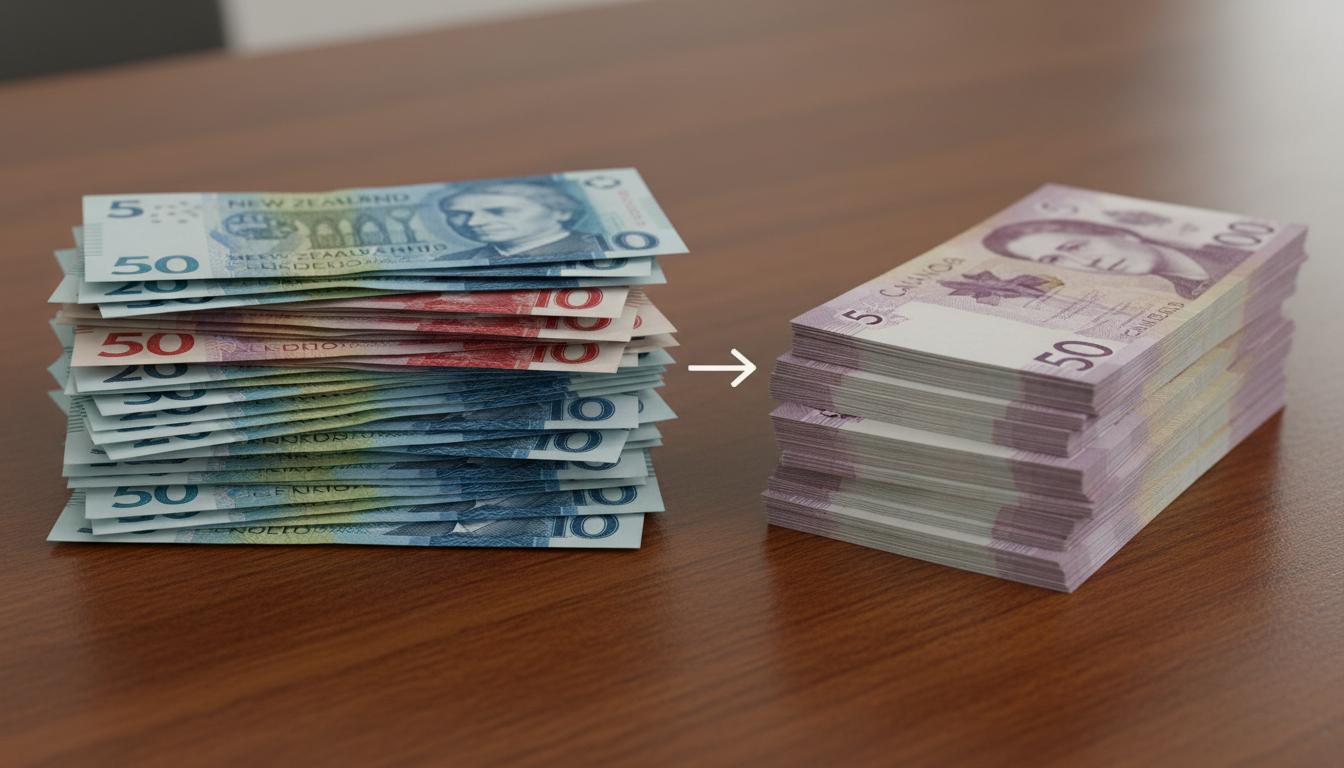
Heading to Vancouver for a ski season, paying Canadian tuition, or getting paid by a client in Toronto? Converting NZD to CAD is simple on the surface, but the details decide how much money lands on the other side. This guide breaks down how the NZD/CAD exchange rate works, what really drives it, the best ways to move your money, and practical steps to get a fair deal without headaches.
What is
NZD to CAD (often written as NZD/CAD) is the exchange rate between the New Zealand dollar (NZD) and the Canadian dollar (CAD). It shows how many Canadian dollars one New Zealand dollar buys. If NZD to CAD is 0.85, then NZ$1 converts to CA$0.85 before any fees.
In currency quotes, NZD is the base currency and CAD is the quote currency. So when NZD/CAD rises, the kiwi buys more Canadian dollars; when it falls, it buys fewer.
Everyday reasons New Zealanders convert NZD to CAD include:
- Travel and holidays in Canada
- Tuition, accommodation, and living costs for study
- Sending money to family or receiving income from Canada
- Paying suppliers, freelancers, or invoices in CAD
- Investing or hedging currency exposure
There are always two versions of the rate in the wild:
- The mid-market rate (the “real” middle between buy/sell prices in the global market)
- The retail rate you actually get (the mid-rate plus a margin or fee from your bank or provider)
How it works
The market behind NZD/CAD
The NZD to CAD exchange rate is set in the global foreign exchange market, traded 24 hours a day, five days a week. Prices move as buyers and sellers react to news, interest rates, and risk sentiment. No single bank or website “sets” the true rate—providers quote around the live interbank rate and add their own margin.
What moves NZD/CAD
- Interest rates: The Reserve Bank of New Zealand (RBNZ) and the Bank of Canada (BoC) influence currency values through their policy rates. Higher rates can attract capital and support a currency.
- Commodities: NZD is tied to dairy and agriculture; CAD often tracks oil. Big swings in global dairy prices or crude oil can nudge NZD/CAD.
- Risk appetite: When markets are confident, “risk” currencies like NZD may strengthen. In market stress, money can flow to perceived safer assets, affecting the pair.
- Economic data: Inflation, employment, GDP, and trade figures from New Zealand and Canada move expectations and the exchange rate.
- China and the US: Because both NZ and Canada trade heavily with these economies, surprises from Beijing or Washington can ripple into NZD/CAD.
What you actually pay
- Exchange rate margin: The difference between the mid-market rate and the rate you’re quoted. This is often the biggest cost.
- Transfer fees: Fixed or percentage fees on top of the rate. Some providers advertise “no fees” but widen the margin instead.
- Receiving fees: A Canadian bank might charge to receive an international transfer.
- Card fees: Credit and debit cards may add foreign transaction fees (often around 1–3%) and use their own conversion rates.
Formula for a quick estimate: NZD amount × your quoted NZD to CAD rate = CAD received before any fixed fees. For example, at 0.85, NZ$1,000 ≈ CA$850 before fees.
Timing and volatility
Markets are most active when major sessions overlap. RBNZ or BoC announcements can cause sharp intraday moves. If you’re moving a large amount, avoid transferring right during big data releases unless you’re comfortable with swings—or use tools like rate alerts, limit orders, or forward contracts to manage timing risk.
Types / examples
Main ways Kiwis convert NZD to CAD
- Banks in NZ: Convenient and trusted, but often include wider margins.
- Online money transfer services: Usually closer to the mid-market rate with clear fees; good for personal and business payments.
- Multi-currency accounts and cards: Hold NZD and CAD, convert when rates suit, and spend in Canada with fewer surprises.
- Credit/debit cards: Easy for travel purchases; watch for foreign transaction fees and dynamic currency conversion (DCC).
- Cash exchange: Handy for small amounts; airport kiosks tend to have poor rates.
- FX brokers: Useful for large transfers, hedging, and forward contracts.
Comparison: NZD to CAD conversion options
| Method | Typical Total Cost | Speed | Best For | Watch Outs |
|---|---|---|---|---|
| NZ Bank transfer | Often 2–4% margin + fee | 1–3 business days | One-off payments, familiarity | Less-transparent margins; receiving bank fees in Canada |
| Online transfer service | Often 0–1% margin + low fee | Same day to 2 days | Personal and SME transfers | Daily limits; ID verification |
| Multi-currency account/card | Near mid-rate; small markup/fee | Instant in-app conversion; spend immediately | Frequent travellers, rate timing | ATM fees; weekend markups with some providers |
| Credit/debit card | Often 1–3% FX fee | Instant at purchase | Everyday spending in Canada | Dynamic currency conversion; cash advance fees |
| Cash exchange | Often 3–10% margin | Instant | Small cash on arrival | Poor airport rates; safety of carrying cash |
| FX broker (forward/limit) | Negotiated; often tight spreads | Same day to 2 days (spot/forward) | Large transfers, hedging | Contract terms; potential deposit/margin |
Note: Costs vary by provider and amount. Always compare the total price: the NZD to CAD rate you’re offered plus every fee.
Everyday examples
- Travel: Convert a small float to CAD before you fly; use a low-fee card and ATMs for the rest. Decline DCC and choose to pay in CAD at terminals.
- Study: Set up recurring transfers for rent and tuition; consider a multi-currency account to convert NZD to CAD when rates look favourable.
- Business: Pay Canadian invoices through an online transfer platform or broker; use forward contracts to lock a budget rate for the quarter.
Pros and cons
Bank transfer
- Pros: Trusted, simple from your existing account, support available.
- Cons: Often higher margins, slower, and receiving bank fees may apply.
Online transfer service
- Pros: Competitive NZD to CAD rates, clear fees, fast delivery, good tracking.
- Cons: Verification steps, limits for very large amounts.
Multi-currency account/card
- Pros: Convert when you like, hold CAD, spend locally, strong visibility on rates.
- Cons: Possible ATM or weekend markups; learning curve for first-time users.
Card spending (credit/debit)
- Pros: Convenience, buyer protection on credit cards.
- Cons: FX fees, cash advances are expensive, DCC traps if you choose to pay in NZD.
Cash exchange
- Pros: Instant cash for taxis and tips.
- Cons: Usually the worst NZD/CAD rates; risk of loss or theft.
FX broker
- Pros: Tight spreads on large sums, forward and limit orders, dedicated support.
- Cons: Paperwork, potential deposits, not ideal for small transfers.
How to use or choose
Step-by-step: Converting NZD to CAD the smart way
- Check the live mid-market rate: Use a reliable rate source to see the real NZD to CAD level.
- Compare providers: Look at banks, online services, and multi-currency accounts. Compare the total cost (rate + fees), not just “no fee” claims.
- Pick speed vs price: If time is tight, pay for speed; otherwise aim for the best overall rate.
- Verify your account: Complete ID checks early to avoid delays when you need to transfer.
- Set up recipient details: Use the correct Canadian account information (account number, institution/transit numbers, or IBAN-equivalent fields required by your provider).
- Lock the rate and send: Confirm the quoted NZD to CAD rate and fees before you click send.
- Track and confirm: Watch for delivery, and ask the recipient to confirm funds arrived as CAD net of any receiving fees.
Choosing the right method
- Small, frequent spends in Canada: Use a low- or no-FX-fee card and avoid DCC by choosing to pay in CAD.
- One-off transfers under, say, NZ$10,000: Online transfer services often beat standard bank rates.
- Large transfers: Consider an FX broker or a service offering forwards and limit orders to manage risk.
- Cash needs: Withdraw CAD at an ATM in Canada with a card that refunds or minimises ATM and FX fees; carry only what you need.
Practical tips for better NZD/CAD outcomes
- Avoid airport exchanges; plan ahead and compare online.
- Set rate alerts for NZD to CAD so you don’t miss favourable moves.
- Transfer on weekdays; many providers add weekend markups when markets are closed.
- For big amounts, split transfers over days to reduce timing risk—or use a forward contract to lock a rate.
- Keep documents handy: proof of funds and purpose to speed up compliance checks.
FAQ
What is the NZD to CAD exchange rate right now?
The rate changes all day. Check a live mid-market rate source, then compare your provider’s NZD to CAD quote (including fees) to see the real cost.
Is it cheaper to exchange NZD to CAD in New Zealand or in Canada?
It depends on the provider, not the country. Airport counters are usually costly. Many Kiwis get better value by using an online transfer or a low-fee card and Canadian ATMs, then comparing total costs.
How can I avoid bad rates when paying in Canada?
When a terminal asks which currency to charge, choose CAD, not NZD. That avoids dynamic currency conversion, which often adds a heavy markup.
What fees should I expect when sending money from NZ to Canada?
Common costs include a rate margin, a transfer fee, and sometimes a receiving fee charged by the Canadian bank. Compare total price before sending.
How long does an NZD to CAD transfer take?
Online services may deliver same day to two business days. Banks can take 1–3 days. Weekends and public holidays add delays.
Can I lock an NZD/CAD rate for the future?
Yes. Some providers and brokers offer forward contracts to secure a rate for a set period, plus limit orders to target a specific rate.
Why does NZD/CAD move with commodities?
NZD benefits from strong dairy and agricultural exports; CAD often responds to oil prices. Shifts in these markets change trade flows and investor expectations, moving the exchange rate.
Are NZD to CAD transfers taxed in New Zealand?
The act of converting currency is not usually taxed. However, the underlying funds (like salary, investment income, or business revenue) can be taxable. Large or complex situations may have reporting or tax implications—seek professional advice if unsure.
What details do I need to send money to a Canadian bank account?
Expect to provide the recipient’s name and address, account number, and the Canadian institution and transit numbers. Your provider will guide you through the exact fields.
Is cash or card better for travel?
Carry a small amount of CAD cash for arrival, then use a low-fee card or ATM withdrawals. Keep backup payment methods in case one fails.
How do I get the best NZD to CAD rate for a large transfer?
- Get quotes from multiple providers, including a broker.
- Ask if pricing improves at higher tiers.
- Use a forward or a limit order to manage timing risk.
- Avoid sending during major data releases if volatility worries you.
What time of day is best to convert NZD to CAD?
There’s no magic hour, but liquidity tends to be stronger during overlapping market sessions. Many retail providers add weekend markups, so weekdays are usually better for conversions.
Can I receive CAD in New Zealand?
Yes. Multi-currency accounts let you hold CAD in New Zealand and convert to NZD when the NZD/CAD rate suits you.
Does paying “no fee” mean the cheapest NZD/CAD conversion?
Not always. A provider can remove the visible fee and widen the exchange rate. Always compare the offered NZD to CAD rate against the live mid-market rate to find the true cost.
Bottom line
The NZD to CAD exchange hinges on more than today’s headline rate. Compare total costs, pick the right tool for your situation, and use simple tactics—rate alerts, weekday transfers, and avoiding DCC—to keep more Canadian dollars in your pocket.